
Food Systems & Ethnobotany 🎯 Grades 4-10 ⏱️ 1 hour 15 minutes 👥 1-30 students

The Science of Jam: Pectin, Acidity & Food Preservation

Food Chemistry & Subsistence Preservation • Tyonek Tribal Conservation District Curriculum

Interactive Digital Curriculum

Interactive Walkthrough Slides

Step through the complete digitized curriculum deck with illustrated concepts, step-by-step procedures, teacher tips, and interactive knowledge checks.

🖥️ Interactive Walkthrough Slides
Slide 1 of 6
Download PDF
Slide 1 Food Science Overview

The Chemistry of Wild Berry Preserves

Pectin, Sugar, and Acid in Food Sovereignty

Transforming wild Alaska berries into sweet, jewel-toned jam is not just culinary art—it is precision biochemistry.

In this science module, students explore the structural chemistry of plant cell walls, carbohydrate polymers, and the chemical triad required for gel formation.

  • 🧪
    Pectin Polymer: A long-chain polysaccharide found in plant cell walls that forms the 3D gel matrix.
  • 🍋
    Acid (pH 2.8–3.5): Neutralizes negative electrical charges on pectin molecules, allowing them to link together.
  • 🍬
    Sugar (60–65%): Dehydrates pectin molecules by attracting water away, forcing chains into a tight web.
← / → Navigate slides F Fullscreen Esc Exit fullscreen
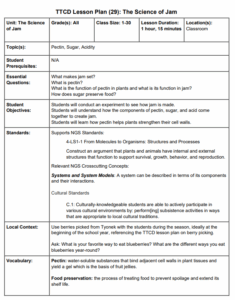
Official curriculum guide preview for The Science of Jam: Pectin, Acidity & Food Preservation
📄 The-Science-of-Jam.pdf

Essential Inquiries & Learning Targets

Core Essential Questions:

  • What chemical conditions (pectin, sugar, acid/pH, temperature) are required to turn liquid fruit juice into a firm gel?
  • Why do wild Alaskan berries (salmonberries, cranberries, blueberries) have different natural pectin levels?
  • How does boiling to the 220°F (104°C) threshold bind sugar and water to prevent bacterial spoilage throughout long northern winters?

Student Learning Objectives:

  • Explore how pectin polysaccharides form a 3D structural mesh that traps liquid.
  • Test fruit juice acidity using pH strips and calculate the ideal gelling window (pH 2.8 - 3.3).
  • Demonstrate water-bath canning safety protocols that eliminate mold, yeast, and anaerobic bacteria like Clostridium botulinum.
Interactive Experiment

Virtual Laboratory Simulator

🔬 Hands-on Virtual STEM Lab Sub-Arctic Food Chemist

Pectin, Acidity & Gelation Matrix Lab

Adjust fruit pH, sugar concentration, and cooking temperature to discover the precise molecular window where berry juice transforms into shelf-stable jam.

Wild Berry Jam Cooking Parameters:

Pectin Cross-linking: Optimal Polymer Mesh
Freezer Spoon Test: Wrinkles Firmly ✓
Final Gel Texture: Perfect Spreadable Jam
Wild Tyonek Salmonberry Preserves
Chemistry: At 220°F and pH 3.1, negative charges on pectin chains are neutralized, allowing calcium and sugar bonds to entrap liquid water into an authentic culinary gel.
Self-Grading Assessment

Comprehension Mastery Quiz

Test student understanding of scientific principles, local Alaska ecology, and problem-solving scenarios from the lesson guide. Earn the Sub-Arctic Food Chemist credential!

📝 Comprehension Mastery Quiz Question 1 of 3

What is the molecular function of pectin in making wild berry jam?

Terminology & Dena’ina Context

Specialized Vocabulary Flashcards

🗂️ Interactive Vocabulary Deck Card 1 of 4

Click the card or press Space to flip. Use arrow keys to navigate.

Term Click to flip ↷

Pectin

Definition & Context Click to flip ↶

A complex structural heteropolysaccharide carbohydrate found in the primary cell walls of plants that forms a culinary gel when combined with acid and sugar.

Alaska Context:

Tart, underripe berries are rich in high-methoxyl pectin, while overripe berries have lost pectin to enzymes.

Educator Guide

Curriculum Standards & Activity Protocol

📚 Standards Alignment (NGSS & Alaska Cultural Standards)

5-PS1-4

Conduct an investigation to determine whether the mixing of two or more substances results in new substances.

NGSS
MS-PS1-2

Analyze and interpret data on the properties of substances before and after the substances interact to determine if a chemical reaction has occurred.

NGSS
Cultural Standard E.2

Culturally-knowledgeable students understand the ecology and geography of the bioregion they inhabit.

Cultural

🏔️ Local Alaskan & Tebughna Context

  • Tebughna families harvest hundreds of pounds of wild berries each July through September on the ridges of Beluga Mountain and surrounding wetlands.
  • Traditional preservation relied on seal oil storage, cold storage in moss-lined birch baskets, and drying.
  • Modern canning combines traditional berry harvest TEK with food science to stock community pantry shelves for the entire winter.

📦 Required Materials & Classroom Setup

✓ 2 cups crushed wild berries (blueberries, salmonberries, or cranberries)✓ 1.5 cups granulated sugar✓ 1 tablespoon lemon juice✓ Commercial fruit pectin (powder or liquid)✓ Candy/fry thermometer (measuring to 230°F+)✓ Small saucepan and wooden spoon✓ Small cold metal spoons placed in freezer (for cold spoon gel test)

🔬 Step-by-Step Hands-on Activity Guide

  1. Step 1: Crush the Fruit & Test pH

    Crush fresh berries in a pot. Dip a pH test strip; if pH is above 3.3, stir in 1 tablespoon of lemon juice.

    💡 Instructor Tip: Tart underripe berries have higher natural pectin than very ripe fruit.

  2. Step 2: Bring to Full Rolling Boil

    Heat berry mixture on stove, stirring constantly. Add sugar and pectin. Watch the bubbles change from frothy to glossy and dense.

    💡 Instructor Tip: Keep thermometer tip submerged in juice without touching pot bottom.

  3. Step 3: The Freezer Spoon Test

    When thermometer hits 220°F, spoon a few drops onto a frozen metal spoon. Let sit 1 minute. Push with your finger: if it wrinkles, the gel has set!

    💡 Instructor Tip: If it runs like syrup, boil for another 2 minutes and re-test.

💬 Wrap-Up Discussion & Evidence of Learning

Discussion Questions:

  • Why does high sugar concentration prevent bacteria and mold from growing on your jam?
  • How does seasonal berry harvesting strengthen Tebughna community food security?

Evidence of Learning Rubric:

  • Student can explain the role of pectin, acid, sugar, and heat in food preservation.
  • Student successfully executes the cold spoon gel test.
← All Youth Lessons & Resources