
Fisheries & Water 🎯 Grades 5-12 ⏱️ 45 minutes 👥 1-30 students

Snowpack Study & Winter Hydrology

Hydrology & Watershed Science • Tyonek Tribal Conservation District Curriculum

Interactive Digital Curriculum

Interactive Walkthrough Slides

Step through the complete digitized curriculum deck with illustrated concepts, step-by-step procedures, teacher tips, and interactive knowledge checks.

🖥️ Interactive Walkthrough Slides
Slide 1 of 6
Download PDF
Slide 1 Watershed Hydrology

The Snowpack: Tyonek's Winter Water Bank

How Frozen Precipitation Sustains Salmon Year-Round

In Western Cook Inlet, winter snowfall does not run off immediately. Instead, it is locked in place across mountains, forests, and muskegs.

This frozen reservoir slowly releases millions of gallons of crystal-clear, oxygen-rich cold water throughout May, June, and July, keeping salmon nursery streams cold and flowing during warm summer months.

  • 🏔️
    Natural Reservoir: Without winter snow, streams would flood violently in winter and run dry in July!
  • ❄️
    Thermal Blanket: Deep snow insulates the ground, preventing salmon redds from freezing solid.
← / → Navigate slides F Fullscreen Esc Exit fullscreen
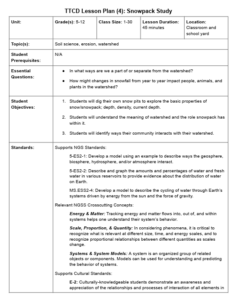
Official curriculum guide preview for Snowpack Study & Winter Hydrology
📄 4.-Snowpack-Study.pdf

Essential Inquiries & Learning Targets

Core Essential Questions:

  • How does the winter snowpack act as a giant frozen water reservoir for the Tyonek watershed?
  • What is Snow Water Equivalent (SWE), and how is it measured in the field?
  • How do snow depth and spring melt timing affect juvenile salmon survival in Cook Inlet streams?

Student Learning Objectives:

  • Dig and examine a snow pit, recording depth, temperature profile, and stratigraphic layers.
  • Calculate Snow Water Equivalent (SWE) by weighing or melting a known volume core of snow.
  • Analyze how changing winter snowfall patterns impact summer stream discharge and water temperatures.
Self-Grading Assessment

Comprehension Mastery Quiz

Test student understanding of scientific principles, local Alaska ecology, and problem-solving scenarios from the lesson guide. Earn the Snowpack Study & Winter Hydrology Master credential!

📝 Comprehension Mastery Quiz Question 1 of 1

What does a high Snow Water Equivalent (SWE) indicate?

Terminology & Dena’ina Context

Specialized Vocabulary Flashcards

🗂️ Interactive Vocabulary Deck Card 1 of 3

Click the card or press Space to flip. Use arrow keys to navigate.

Term Click to flip ↷

Snowpack

Definition & Context Click to flip ↶

The seasonal accumulation of snow that compresses under its own weight over winter.

Alaska Context:

Hydrology

Educator Guide

Curriculum Standards & Activity Protocol

📚 Standards Alignment (NGSS & Alaska Cultural Standards)

MS-ESS2-4

Develop a model to describe the cycling of water through Earth's systems driven by energy from the sun and the force of gravity.

NGSS

🏔️ Local Alaskan & Tebughna Context

  • The Chuitna River, Beluga River, and Tyonek creeks receive a substantial portion of their spring and summer baseflows from melting alpine snow in the Tordrillo and Alaska Ranges.
  • A deep winter snowpack insulates salmon gravel redds from freezing solid during extreme sub-zero arctic cold snaps.

📦 Required Materials & Classroom Setup

✓ Avalanche shovels✓ Dial stem thermometers✓ Calibrated snow measurement tubes / scales✓ Crystal cards & 10x hand lenses✓ Clipboards & waterproof paper

🔬 Step-by-Step Hands-on Activity Guide

  1. Step 1: Pit Excavation

    Dig vertical snow pit down to ground surface.

  2. Step 2: Temperature Profile

    Insert thermometers every 10 cm and record readings after 2 minutes.

  3. Step 3: Density Sampling

    Extract known volume snow core and weigh to calculate density.

  4. Step 4: Calculate SWE

    Multiply snow depth by density to find liquid water equivalent.

💬 Wrap-Up Discussion & Evidence of Learning

Discussion Questions:

  • How does early spring snowmelt affect Tyonek rivers during July subsistence fishing?
  • Why is fresh powder snow less dense than compacted spring snow?

Evidence of Learning Rubric:

  • Student accurately profiles snow pit layers and measures temperature gradient.
  • Student correctly calculates SWE from depth and density measurements.
← All Youth Lessons & Resources