Ecosystems & Wildlife 🎯 Grades K-8 ⏱️ 1 hour 👥 1-30 students

Scientific Observation & Micro-Plot Inquiries

Field Biology & Scientific Methodology • Tyonek Tribal Conservation District Curriculum

Interactive Digital Curriculum

Interactive Walkthrough Slides

Step through the complete digitized curriculum deck with illustrated concepts, step-by-step procedures, teacher tips, and interactive knowledge checks.

🖥️ Interactive Walkthrough Slides
Slide 1 of 6
Download PDF
Slide 1 Scientific Methodology

Scientific Observation vs Inference

The Foundation of All Scientific Inquiry

Science begins with curiosity and disciplined observation. But human brains constantly jump to conclusions!

Observation: Objective information gathered directly through the five senses without bias (e.g., "The spruce bark has a 2-inch tear with sticky yellow resin oozing out").

Inference: An assumption, conclusion, or hypothesis based on prior knowledge (e.g., "A brown bear scratched this tree this morning").

⚡ Quick Knowledge Pulse Choose 1 answer

Which of the following statements is an objective SCIENTIFIC OBSERVATION?

← / → Navigate slides F Fullscreen Esc Exit fullscreen
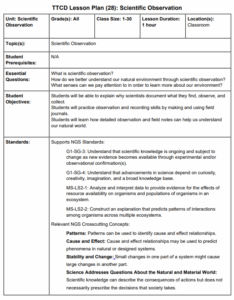
Official curriculum guide preview for Scientific Observation & Micro-Plot Inquiries
📄 Scientific-Observation.pdf

Essential Inquiries & Learning Targets

Core Essential Questions:

  • What is the fundamental difference between an objective scientific observation and a subjective inference or opinion?
  • How do field scientists systematically record data using all five senses without disturbing wild organisms?
  • What ecological interactions can be discovered inside a 1-meter micro-plot in a coastal sub-arctic forest?

Student Learning Objectives:

  • Differentiate between qualitative descriptions, quantitative measurements, and inferences.
  • Execute a 1-meter square micro-plot field survey in local forest or beach terrain.
  • Record detailed field sketches with labeled parts, scale bars, and environmental metadata (temperature, cloud cover, wind).
Interactive Experiment

Virtual Laboratory Simulator

🔬 Hands-on Virtual STEM Lab Master Field Naturalist

1-Meter Forest Micro-Plot Observation Tool

Explore an interactive 1-meter square boreal forest micro-plot. Click animal signs, fungi, and seedlings, and classify statements as objective observation vs inference.

Field Inquiry Parameters:

Explore step-by-step variables, observation metadata, and field testing protocols directly from the official TTCD curriculum guide.

Active Protocol: 1-Meter Forest Micro-Plot Observation Tool
Status: Standards Verified ✓
📋 Protocol Checklist
  • Follow teacher safety guidance and ethical collection standards.
  • Record 3 independent trials for data repeatability.
  • Compare local Tyonek observations with published Alaska State Standards.
Self-Grading Assessment

Comprehension Mastery Quiz

Test student understanding of scientific principles, local Alaska ecology, and problem-solving scenarios from the lesson guide. Earn the Master Field Naturalist credential!

📝 Comprehension Mastery Quiz Question 1 of 1

Which of the following is a pure scientific OBSERVATION rather than an inference?

Terminology & Dena’ina Context

Specialized Vocabulary Flashcards

🗂️ Interactive Vocabulary Deck Card 1 of 3

Click the card or press Space to flip. Use arrow keys to navigate.

Term Click to flip ↷

Objective Observation

Definition & Context Click to flip ↶

Factual information collected directly through the five senses or scientific instruments without bias, assumptions, or personal opinions.

Alaska Context:

Example: "The moose track is 14 cm long and 11 cm wide in moist grey silt."

Educator Guide

Curriculum Standards & Activity Protocol

📚 Standards Alignment (NGSS & Alaska Cultural Standards)

5-PS1-3

Make observations and measurements to identify materials based on their properties.

NGSS
Cultural Standard E.2

Culturally-knowledgeable students understand the ecology and geography of the bioregion they inhabit.

Cultural

🏔️ Local Alaskan & Tebughna Context

  • Tebughna elders have practiced meticulous observation of animal sign, tide changes, and wind directions for thousands of years as an essential survival skill.
  • Scientific observation bridges traditional hunter tracking skills with modern environmental science data logging.
  • Observing subtle changes in lichen growth, tracks in mud, and bird arrivals provides early warnings of ecosystem shifts.

📦 Required Materials & Classroom Setup

✓ 4 wooden stakes or survey flags✓ 4 meters of bright string or rope to border a 1x1 meter square✓ Botanical hand lens / magnifier✓ Field notebook, ruler, and colored pencils✓ Digital stem thermometer

🔬 Step-by-Step Hands-on Activity Guide

  1. Step 1: Establish the 1-Meter Micro-Plot

    Toss a beanbag blindly to avoid human selection bias. Center your 1x1 meter boundary string where the beanbag landed.

    💡 Instructor Tip: Do not disturb twigs or step inside your square boundary.

  2. Step 2: Record Environmental Metadata

    Log time, ambient air temperature, soil temperature, weather conditions, and GPS coordinates.

    💡 Instructor Tip: Metadata provides vital context for comparing data year-to-year.

  3. Step 3: Sensory Observation & Sketch

    Spend 20 minutes silently cataloging everything inside the plot. Record counts of plant species, insects, leaf litter depth, and signs of animal activity.

    💡 Instructor Tip: Create a scale sketch with a 10 cm scale bar.

💬 Wrap-Up Discussion & Evidence of Learning

Discussion Questions:

  • Why must field scientists separate what they actually see from what they guess happened?
  • How does careful observation keep hunters safe when tracking wildlife in the Tyonek woods?

Evidence of Learning Rubric:

  • Student can classify 5 statements into Observations vs Inferences with 100% accuracy.
  • Student produces a complete, labeled field sketch with environmental metadata.
← All Youth Lessons & Resources