
Soil & Agriculture 🎯 Grades K-8 ⏱️ 60 minutes 👥 1-30 students

Sand, Silt, and Clay Game & Soil Demonstration

Soil Science & Texture Dynamics • Tyonek Tribal Conservation District Curriculum

Interactive Digital Curriculum

Interactive Walkthrough Slides

Step through the complete digitized curriculum deck with illustrated concepts, step-by-step procedures, teacher tips, and interactive knowledge checks.

🖥️ Interactive Walkthrough Slides
Slide 1 of 6
Download PDF
Slide 1 Particle Scale Science

Soil Texture: The Three Mineral Fractions

Sand, Silt, and Clay Size Scale

Soil texture refers to the proportions of three different particle sizes: sand, silt, and clay.

To visualize their extreme size differences, imagine a grain of sand is as large as a basketball! A particle of silt would be the size of a baseball, and a clay particle would be smaller than a tiny marble.

  • 🏀
    Sand (Gritty): 0.05 to 2.0 millimeters. Visible to the naked eye.
  • ⚾
    Silt (Smooth / Silky): 0.002 to 0.05 millimeters. Feels like flour on skin.
  • 🔮
    Clay (Sticky / Microscopic): Less than 0.002 millimeters. Requires an electron microscope to see.
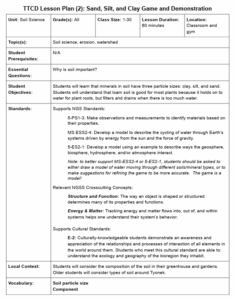
← / → Navigate slides F Fullscreen Esc Exit fullscreen
Official curriculum guide preview for Sand, Silt, and Clay Game & Soil Demonstration
📄 2.-Sand-Silt-and-Clay-Game-and-Demonstration.docx-1-.pdf

Essential Inquiries & Learning Targets

Core Essential Questions:

  • How do the microscopic sizes of sand, silt, and clay particles determine how soil feels and behaves?
  • How does soil texture govern water infiltration, aeration, and root growth in Alaska?
  • What field tests allow farmers to determine soil texture without laboratory equipment?

Student Learning Objectives:

  • Compare particle sizes using the basketball (sand), baseball (silt), and marble (clay) analogy.
  • Participate in the Human Particle Game to simulate pore spaces and water percolation.
  • Perform the tactile Soil Ribbon Test to classify local soil into sand, loam, or clay.
Self-Grading Assessment

Comprehension Mastery Quiz

Test student understanding of scientific principles, local Alaska ecology, and problem-solving scenarios from the lesson guide. Earn the Sand, Silt, and Clay Game & Soil Demonstration Master credential!

📝 Comprehension Mastery Quiz Question 1 of 2

Which soil mineral particle has the smallest individual diameter?

Terminology & Dena’ina Context

Specialized Vocabulary Flashcards

🗂️ Interactive Vocabulary Deck Card 1 of 4

Click the card or press Space to flip. Use arrow keys to navigate.

Term Click to flip ↷

Soil Texture

Definition & Context Click to flip ↶

The relative proportion of sand, silt, and clay mineral particles in a soil sample.

Alaska Context:

Soil Science

Educator Guide

Curriculum Standards & Activity Protocol

📚 Standards Alignment (NGSS & Alaska Cultural Standards)

5-PS1-3

Make observations and measurements to identify materials based on their properties.

NGSS

🏔️ Local Alaskan & Tebughna Context

  • Glacial rivers in the Cook Inlet basin carry massive loads of glacial flour (silt) that form wide mudflats and fertile valley bottoms.
  • Sandy coastal ridges around Tyonek drain water rapidly, requiring high organic matter additions to retain irrigation water.

📦 Required Materials & Classroom Setup

✓ Sand, silt, and clay reference samples✓ Local garden soil✓ Water squirt bottles✓ Rulers✓ Paper towels

🔬 Step-by-Step Hands-on Activity Guide

  1. Step 1: Particle Game

    Perform the Human Particle Game simulating sand, silt, and clay spacing.

  2. Step 2: Feel Test

    Rub dry and moist samples between fingers to feel grit vs smoothness.

  3. Step 3: Ribbon Test

    Form moist soil balls and squeeze out ribbons over a ruler.

  4. Step 4: Texture Chart

    Determine USDA soil texture class and log in science binder.

💬 Wrap-Up Discussion & Evidence of Learning

Discussion Questions:

  • Why does water pool on top of clay soil while soaking instantly through sand?
  • Why is loam considered the best soil texture for growing potatoes and cabbages?

Evidence of Learning Rubric:

  • Student can describe the physical differences between sand, silt, and clay.
  • Student successfully executes the ribbon test and explains their finding.
← All Youth Lessons & Resources