
Fisheries & Water 🎯 Grades K-12 ⏱️ 60-90 minutes 👥 10-25 students

Salmon Life Cycle Tag & Migration Ecology

Fisheries & Watershed Science • Tyonek Tribal Conservation District Curriculum

Interactive Digital Curriculum

Interactive Walkthrough Slides

Step through the complete digitized curriculum deck with illustrated concepts, step-by-step procedures, teacher tips, and interactive knowledge checks.

🖥️ Interactive Walkthrough Slides
Slide 1 of 6
Download PDF
Slide 1 Species Overview

The Anadromous Marvel: Pacific Salmon

The Six Life Stages of łiq’a

Pacific salmon are legendary travelers. Born in cold, bubbling freshwater gravel beds in the shadow of Alaska mountain ranges, they journey thousands of miles into the stormy North Pacific Ocean before returning home to complete the circle of life.

In Dena’ina, salmon is called łiq’a. Salmon are the lifeblood of Tyonek: feeding families, nourishing bears and eagles, and fertilizing forest trees with ocean marine nutrients.

  • 🐟
    Six Stages: 1. Egg → 2. Alevin → 3. Fry → 4. Parr → 5. Smolt → 6. Adult Spawner
← / → Navigate slides F Fullscreen Esc Exit fullscreen
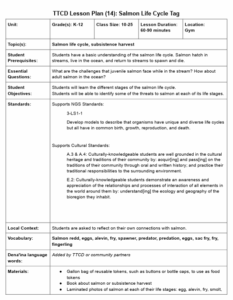
Official curriculum guide preview for Salmon Life Cycle Tag & Migration Ecology
📄 14.-Salmon-Life-Cycle-Tag.pdf

Essential Inquiries & Learning Targets

Core Essential Questions:

  • What are the six distinct stages in the anadromous life cycle of Pacific salmon (Oncorhynchus spp. / łiq’a)?
  • How do physiological adaptations allow salmon to transition from freshwater streams to the salty open ocean and back?
  • What natural hazards and human obstacles must salmon overcome to return to their birth gravel to spawn?

Student Learning Objectives:

  • Identify and sequence the 6 life cycle stages: Egg, Alevin, Fry, Parr, Smolt, and Adult Spawner.
  • Participate in the active gym/field tag simulation navigating predatory obstacles and hydraulic barriers.
  • Explain the cultural significance of łiq’a as the economic and spiritual backbone of Tebughna life.
Self-Grading Assessment

Comprehension Mastery Quiz

Test student understanding of scientific principles, local Alaska ecology, and problem-solving scenarios from the lesson guide. Earn the Salmon Life Cycle Tag & Migration Ecology Master credential!

📝 Comprehension Mastery Quiz Question 1 of 1

What critical physiological process allows freshwater salmon to enter salty ocean water without dehydrating?

Terminology & Dena’ina Context

Specialized Vocabulary Flashcards

🗂️ Interactive Vocabulary Deck Card 1 of 4

Click the card or press Space to flip. Use arrow keys to navigate.

Term Click to flip ↷

Anadromous

Definition & Context Click to flip ↶

Fishes that hatch in freshwater, migrate to the ocean to mature, and return to freshwater to spawn.

Alaska Context:

Ichthyology

Educator Guide

Curriculum Standards & Activity Protocol

📚 Standards Alignment (NGSS & Alaska Cultural Standards)

3-LS1-1

Develop models to describe that organisms have unique and diverse life cycles but all have in common birth, growth, reproduction, and death.

NGSS

🏔️ Local Alaskan & Tebughna Context

  • Tyonek subsistence fishers target king (Chinook) salmon in May–June and silver (coho) salmon in July–August using beach setnets.
  • The Chuitna, Beluga, and Theodore Rivers provide vital spawning gravels for all five wild Pacific salmon species.

📦 Required Materials & Classroom Setup

✓ Gym or outdoor playing field✓ Cones to mark Freshwater, Estuary, and Ocean zones✓ Foam hurdles to simulate culverts✓ Pinnies or jerseys for predators (Pike, Bear, Fisher)

🔬 Step-by-Step Hands-on Activity Guide

  1. Step 1: Setup Migration

    Mark Stream, Ocean, and Spawning zones across field.

  2. Step 2: Assign Hazards

    Designate 3–4 predator taggers and 1 perched culvert obstacle.

  3. Step 3: Simulate Run

    Salmon players attempt to navigate through life stages to spawn.

  4. Step 4: Survival Rate

    Count surviving adult spawners and calculate percentage survival.

💬 Wrap-Up Discussion & Evidence of Learning

Discussion Questions:

  • Out of 3,000 eggs laid in a redd, why do only 2 to 4 adults typically survive to spawn?
  • How do dying spawned-out salmon nourish the spruce forests along the riverbanks?

Evidence of Learning Rubric:

  • Student accurately sequences the 6 stages of the salmon life cycle.
  • Student articulates how human stream restoration (culvert fixes) directly increases salmon survival.
← All Youth Lessons & Resources