
Permafrost & Frozen Ground Dynamics
Arctic & Sub-Arctic Geomorphology • Tyonek Tribal Conservation District Curriculum
Interactive Walkthrough Slides
Step through the complete digitized curriculum deck with illustrated concepts, step-by-step procedures, teacher tips, and interactive knowledge checks.
Essential Inquiries & Learning Targets
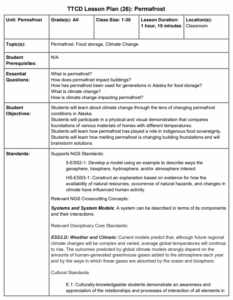
Core Essential Questions:
- What is permafrost, and where is it distributed across Alaska?
- How does heat conducted from buildings impact underlying frozen ground?
- How have Alaska Native communities utilized permafrost for generations to maintain food sovereignty?
- How is climate change accelerating permafrost thaw, and what engineering solutions exist to stabilize sub-arctic infrastructure?
Student Learning Objectives:
- Investigate climate change through the lens of shifting permafrost boundaries across Alaska.
- Conduct a 4-mug physical heat-transfer demonstration comparing foundation materials and elevation.
- Analyze how indigenous ice cellars (sigluaq) protect harvested meat without fossil fuel refrigeration.
- Evaluate architectural engineering adaptations including passive thermosyphons and ventilated piling foundations.
Virtual Laboratory Simulator
4-Mug Foundation Heat-Transfer Simulator
Model the physical heat conduction from heated buildings into frozen ground. Compare uninsulated ground slabs, insulated sub-slabs, and elevated pilings under varying climate temperatures.
Select Foundation Method (4-Mug Demonstration):
Comprehension Mastery Quiz
Test student understanding of scientific principles, local Alaska ecology, and problem-solving scenarios from the lesson guide. Earn the Arctic Foundation Engineer credential!
Scientifically, what defines permafrost?
Specialized Vocabulary Flashcards
Click the card or press Space to flip. Use arrow keys to navigate.
Permafrost
/PER-muh-frawst/
Ground (soil, sediment, or bedrock with organic matter) that remains continuously at or below 0°C (32°F) for at least two consecutive years.
Permafrost underlies roughly 85% of Alaska, varying from continuous thick sheets in the North Slope to patchy discontinuous zones in Southcentral.
Curriculum Standards & Activity Protocol
📚 Standards Alignment (NGSS & Alaska Cultural Standards)
Develop a model using an example to describe ways the geosphere, biosphere, hydrosphere, and atmosphere interact.
NGSSConstruct an explanation based on evidence for how natural hazards and changes in climate have influenced human activity.
NGSSCulturally-knowledgeable students understand the ecology and geography of the bioregion they inhabit.
CulturalCulturally-knowledgeable students demonstrate an awareness of how and why cultures adapt and change over time.
Cultural🏔️ Local Alaskan & Tebughna Context
- Discuss how permafrost underlies approximately 85% of Alaska, with discontinuous and sporadic zones throughout Southcentral and Cook Inlet.
- Explore how coastal bluff slumping near Tyonek accelerates when subsurface ice wedges thaw and meet high-energy tidal currents.
- Examine the vulnerability of ancestral ice cellars in northern whaling communities where thawing permafrost causes collapse and spoilage.
📦 Required Materials & Classroom Setup
🔬 Step-by-Step Hands-on Activity Guide
- Step 1: Prepare the Permafrost Bed
Mix garden soil and water in the baking pan to create a level, saturated slurry. Freeze for 24 hours to form an authentic dense permafrost ice-soil matrix.
💡 Instructor Tip: Ensure the top surface is flat so all 4 mugs start on level ground.
- Step 2: Mug 1 (Unheated Baseline Control)
Fill Mug 1 with ice cubes and place directly onto the frozen soil block. This simulates an unheated warehouse, ice cache, or ambient shed.
💡 Instructor Tip: Record initial surface level.
- Step 3: Mug 2 (Uninsulated Heated Slab)
Fill Mug 2 with hot water (~180°F) and place directly on the frozen soil without any barrier. This models a heated home built directly on ground.
💡 Instructor Tip: Watch closely! Heat conduction starts immediately.
- Step 4: Mug 3 (Sub-Slab Rigid Insulation)
Place a small square of foam insulation on the soil, then rest Mug 3 (filled with hot water) on top. This models modern sub-slab rigid insulation.
💡 Instructor Tip: Compare how much less thermal energy conducts into the soil.
- Step 5: Mug 4 (Elevated Pilings with Air Circulation)
Elevate Mug 4 on three plastic Lego blocks or dominoes 1 inch above the frozen soil, then fill with hot water. This models an elevated pile foundation.
💡 Instructor Tip: Feel the air circulating in the gap beneath Mug 4.
- Step 6: Timed Observation & Measurement
Run the timer for 10, 20, and 30 minutes. Measure meltwater depth, soil depression under each mug, and whether Mug 2 begins tilting.
💡 Instructor Tip: Mug 2 typically sinks 10-25mm and leans precariously as thaw settlement undermines its footing.
💬 Wrap-Up Discussion & Evidence of Learning
Discussion Questions:
- Which mug caused the most catastrophic melting and foundation settlement? Why?
- Why did Mug 4 protect the permafrost even though it held the same boiling water as Mug 2?
- How does passive ventilation beneath a piling home mimic natural sub-arctic winter cooling?
- If you were designing a new school or community hall in rural Alaska, what foundation system would you recommend to the tribal council?
Evidence of Learning Rubric:
- Student can explain conductive heat transfer through different building foundation types.
- Student sketches a cross-section showing active layer, permafrost boundary, and elevated pilings.
- Student articulates the connection between melting permafrost and threats to traditional food caches.