
Ecosystems & Wildlife 🎯 Grades 4-10 ⏱️ 1 hour 15 minutes 👥 1-30 students

Mushrooms & Sub-Arctic Fungal Ecology

Mycology, Decomposers & Mycorrhizae • Tyonek Tribal Conservation District Curriculum

Interactive Digital Curriculum

Interactive Walkthrough Slides

Step through the complete digitized curriculum deck with illustrated concepts, step-by-step procedures, teacher tips, and interactive knowledge checks.

🖥️ Interactive Walkthrough Slides
Slide 1 of 6
Download PDF
Slide 1 Fungal Biology

Kingdom Fungi: The Hidden Forest Web

The Vast Underground Mycelial Network

Mushrooms are neither plants nor animals—they belong to their own evolutionary kingdom: Kingdom Fungi!

The mushroom you see on the forest floor is just the temporary "apple" on a vast underground tree. Beneath the moss lies the mycelium: miles of microscopic branching threads (hyphae) that weave through every cubic inch of forest soil.

  • 🕸️
    Ecosystem Web: A single cubic centimeter of forest soil can contain over a mile of fungal mycelium.
  • 🌲
    Wood Wide Web: Mycorrhizal fungi share sugars, minerals, and defense warnings between trees.
← / → Navigate slides F Fullscreen Esc Exit fullscreen
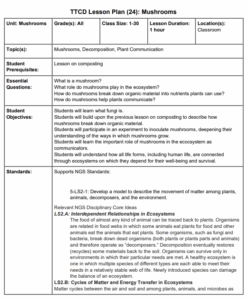
Official curriculum guide preview for Mushrooms & Sub-Arctic Fungal Ecology
📄 Mushrooms-1.pdf

Essential Inquiries & Learning Targets

Core Essential Questions:

  • What is the difference between the visible mushroom fruit body and the underground mycelial network?
  • How do mycorrhizal fungi partner with birch and spruce tree roots in Western Cook Inlet boreal forests?
  • How do fungal decomposers recycle dead organic matter into fertile soil, and how do you make a botanical spore print?

Student Learning Objectives:

  • Identify fungal anatomy: cap (pileus), gills (lamellae), stem (stipe), ring (annulus), and mycelium.
  • Create a botanical spore print to observe microscopic reproductive spore color patterns.
  • Classify saprophytic decomposers versus symbiotic mycorrhizal forest fungi.
Interactive Experiment

Virtual Laboratory Simulator

🔬 Hands-on Virtual STEM Lab Forest Mycologist

Spore Print & Fungal Anatomy Simulator

Dissect mushroom morphology and simulate an overnight spore print drop to identify fungal spore pigments under magnification.

Field Inquiry Parameters:

Explore step-by-step variables, observation metadata, and field testing protocols directly from the official TTCD curriculum guide.

Active Protocol: Spore Print & Fungal Anatomy Simulator
Status: Standards Verified ✓
📋 Protocol Checklist
  • Follow teacher safety guidance and ethical collection standards.
  • Record 3 independent trials for data repeatability.
  • Compare local Tyonek observations with published Alaska State Standards.
Self-Grading Assessment

Comprehension Mastery Quiz

Test student understanding of scientific principles, local Alaska ecology, and problem-solving scenarios from the lesson guide. Earn the Forest Mycologist credential!

📝 Comprehension Mastery Quiz Question 1 of 2

What is the main body of a fungus that lives underground year-round?

Terminology & Dena’ina Context

Specialized Vocabulary Flashcards

🗂️ Interactive Vocabulary Deck Card 1 of 3

Click the card or press Space to flip. Use arrow keys to navigate.

Term Click to flip ↷

Mycelium

Definition & Context Click to flip ↶

The vegetative part of a fungus, consisting of a vast subterranean network of fine white branching thread-like filaments called hyphae.

Alaska Context:

A single teaspoon of healthy Tyonek forest soil contains several miles of microscopic fungal mycelium.

Educator Guide

Curriculum Standards & Activity Protocol

📚 Standards Alignment (NGSS & Alaska Cultural Standards)

5-LS2-1

Develop a model to describe the movement of matter among plants, animals, decomposers, and the environment.

NGSS
MS-LS2-3

Develop a model to describe the cycling of matter and flow of energy among living and nonliving parts of an ecosystem.

NGSS
Cultural Standard E.2

Culturally-knowledgeable students understand the ecology and geography of the bioregion they inhabit.

Cultural

🏔️ Local Alaskan & Tebughna Context

  • Tyonek boreal forests are carpeted with mycorrhizal fungi that exchange nitrogen and phosphorus for sugars produced by birch and spruce needles.
  • Birch polypore and chaga (Inonotus obliquus) have been utilized traditionally across Dena’ina territory for tinder, medicine, and smudging.
  • Always emphasize strict foraging ethics: never consume wild mushrooms without expert mycological identification.

📦 Required Materials & Classroom Setup

✓ Fresh mature gilled mushrooms (store-bought Portobello or button mushrooms for classroom safety)✓ Index cards cut in half (one white, one black taped together)✓ Clear glass bowls or plastic cups (to cover caps)✓ Sharp paring knife (adult use to remove stems)✓ Water droplets and hairspray (to fix finished spore prints)

🔬 Step-by-Step Hands-on Activity Guide

  1. Step 1: Remove the Stipe (Stem)

    Carefully cut or twist off the stem flush with the bottom of the mushroom cap so the gills can rest flat against paper.

    💡 Instructor Tip: Do not damage the radiating gill gills.

  2. Step 2: Position on Split Paper

    Place the cap gills-down directly over the boundary line between the white and black index cards. Cover with a glass bowl to prevent drafts.

    💡 Instructor Tip: The two-color paper guarantees spores are visible whether they are pure white or dark brown.

  3. Step 3: Overnight Spore Drop

    Place a drop of water on top of the cap and leave undisturbed for 6-12 hours. Billions of microscopic spores will drop onto the paper.

    💡 Instructor Tip: Lift the cap straight up to reveal a stunning radiating starburst spore pattern!

💬 Wrap-Up Discussion & Evidence of Learning

Discussion Questions:

  • Why are decomposers like fungi essential for nutrient cycling in the Tyonek community gardens and forests?
  • Why should you never eat a wild mushroom without expert positive identification?

Evidence of Learning Rubric:

  • Student successfully produces a clear radiating spore print.
  • Student can label all five anatomical parts of a mushroom cap.
← All Youth Lessons & Resources