
Invasive Species 🎯 Grades 3-12 ⏱️ 60 minutes 👥 15-25 students

Invasive Pike Simulation Game & Food Web Dynamics

Invasive Species & Population Ecology • Tyonek Tribal Conservation District Curriculum

Interactive Digital Curriculum

Interactive Walkthrough Slides

Step through the complete digitized curriculum deck with illustrated concepts, step-by-step procedures, teacher tips, and interactive knowledge checks.

🖥️ Interactive Walkthrough Slides
Slide 1 of 6
Download PDF
Slide 1 Ecosystem Dynamics

When the Balance Shatters: Trophic Cascades

What Happens When an Apex Invader Enters a Pristine Lake?

In a healthy West Cook Inlet lake, native rainbow trout, Dolly Varden, sticklebacks, and juvenile salmon co-exist in an intricate balance regulated by food supply, water temperatures, and seasonal floods.

When invasive Northern Pike enter the system, they act as ecological vacuum cleaners, devouring every fish they can fit in their mouths until the entire food web collapses!

  • 🌊
    Round 1 Baseline: Healthy lake with 20 salmon fry and 0 pike.
  • 🦈
    Round 2 Invasion: Introduction of 2 ambush pike predators.
  • 📉
    Round 3 Infestation: Pike population doubles, wiping out 90% of salmon.
  • 🛡️
    Round 4 Suppression: TTCD technicians install gillnets, removing pike and restoring survival.
← / → Navigate slides F Fullscreen Esc Exit fullscreen
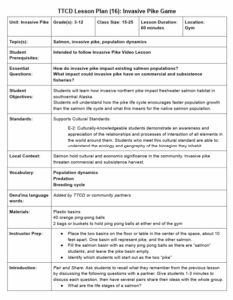
Official curriculum guide preview for Invasive Pike Simulation Game & Food Web Dynamics
📄 16.-Invasive-Pike_-Game.pdf

Essential Inquiries & Learning Targets

Core Essential Questions:

  • How does the introduction of a single novel apex predator trigger a trophic cascade across an entire lake?
  • What mathematical patterns occur when invasive predators exhaust their primary prey source?
  • How does suppression netting interrupt this ecological collapse to give native salmon fry a fighting chance?

Student Learning Objectives:

  • Simulate trophic interactions in a healthy lake vs an invaded lake through active physical roleplay.
  • Collect and graph empirical survival data over 4 distinct simulation rounds.
  • Calculate the survival percentage of juvenile salmon when suppression netting is implemented.
Self-Grading Assessment

Comprehension Mastery Quiz

Test student understanding of scientific principles, local Alaska ecology, and problem-solving scenarios from the lesson guide. Earn the Invasive Pike Simulation Game & Food Web Dynamics Master credential!

📝 Comprehension Mastery Quiz Question 1 of 1

What is the primary ecological consequence when an invasive predator consumes all native prey in a lake?

Terminology & Dena’ina Context

Specialized Vocabulary Flashcards

🗂️ Interactive Vocabulary Deck Card 1 of 3

Click the card or press Space to flip. Use arrow keys to navigate.

Term Click to flip ↷

Trophic Cascade

Definition & Context Click to flip ↶

Ecological disruptions that ripple through multiple feeding levels when a top predator is added or removed.

Alaska Context:

Ecology

Educator Guide

Curriculum Standards & Activity Protocol

📚 Standards Alignment (NGSS & Alaska Cultural Standards)

MS-LS2-2

Construct an explanation that predicts patterns of interactions among organisms across multiple ecosystems.

NGSS

🏔️ Local Alaskan & Tebughna Context

  • In Alexander Lake in the Susitna drainage, coho salmon runs collapsed by over 80% following pike establishment.
  • TTCD's community gillnetting efforts remove thousands of pike annually, directly stabilizing surviving smolt out-migration.

📦 Required Materials & Classroom Setup

✓ Poker chips or beanbags (food tokens)✓ Gym floor or outdoor grass court✓ Pinnies for Salmon and Pike roles✓ Boundary mats representing weed beds✓ Foam noodles representing suppression gillnets

🔬 Step-by-Step Hands-on Activity Guide

  1. Step 1: Round 1 Baseline

    Salmon forage for tokens with zero pike predators.

  2. Step 2: Round 2 Invasion

    Introduce 2 ambush pike hidden in weed beds.

  3. Step 3: Round 3 Explosion

    Increase pike predators to 5 and observe mortality.

  4. Step 4: Round 4 Suppression

    Introduce TTCD netting team to control pike and measure recovery.

💬 Wrap-Up Discussion & Evidence of Learning

Discussion Questions:

  • How did your foraging behavior change once you knew pike were hiding in the weeds?
  • Why is prevention much cheaper and easier than suppression netting?

Evidence of Learning Rubric:

  • Student accurately graphs multi-round survival data showing the impact of invasive predators.
  • Student explains the mechanism of trophic cascades in freshwater ecosystems.
← All Youth Lessons & Resources