
Fish Passage Restoration & Stream Culverts
Hydrology & Watershed Engineering • Tyonek Tribal Conservation District Curriculum
Interactive Walkthrough Slides
Step through the complete digitized curriculum deck with illustrated concepts, step-by-step procedures, teacher tips, and interactive knowledge checks.
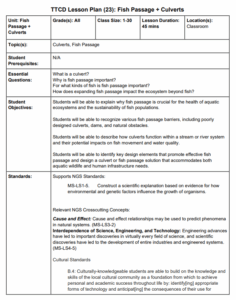
Essential Inquiries & Learning Targets
Core Essential Questions:
- How do road crossings and corrugated metal culverts block Pacific salmon migrations in Alaska?
- What hydraulic conditions (velocity, water depth, outlet perch height) create physical barriers for juvenile coho versus adult king salmon?
- How does stream simulation engineering and bottomless arch culvert design restore natural fish passage?
Student Learning Objectives:
- Measure hydraulic flow velocity and outfall drop height to determine fish passage eligibility.
- Compare juvenile salmon swim capabilities (burst speed vs sustained cruise) against culvert flow rates.
- Evaluate TTCD restoration projects that replace failing undersized round pipes with natural-bottom arch crossings.
Virtual Laboratory Simulator
Culvert Hydraulic Barrier & Jump Calculator
Calculate water velocity, drop height, and passage pass/fail criteria for juvenile coho and adult salmon. Compare undersized smooth pipes against open-bottom arch bridges.
Stream Crossing Design Parameters:
Comprehension Mastery Quiz
Test student understanding of scientific principles, local Alaska ecology, and problem-solving scenarios from the lesson guide. Earn the Watershed Fish Passage Assessor credential!
Why are juvenile coho salmon (fry and parr) much more vulnerable to culvert barriers than adult king salmon?
Specialized Vocabulary Flashcards
Click the card or press Space to flip. Use arrow keys to navigate.
Perched Culvert Outfall
A condition where stream erosion has scoured the downstream streambed lower than the culvert lip, creating an artificial waterfall drop.
Perched heights greater than 4-6 inches prevent juvenile salmon from jumping into the pipe.
Curriculum Standards & Activity Protocol
📚 Standards Alignment (NGSS & Alaska Cultural Standards)
Apply scientific principles to design a method for monitoring and minimizing a human impact on the environment.
NGSSDesign, evaluate, and refine a solution for reducing the impacts of human activities on the environment and biodiversity.
NGSSCulturally-knowledgeable students recognize and build upon the interrelationships between natural and human realms.
Cultural🏔️ Local Alaskan & Tebughna Context
- Resource roads, logging roads, and airport access roads in the Tyonek District cross critical salmon rearing streams.
- Juvenile coho salmon must migrate upstream into cool headwater tributaries during hot summer months and into deep overwintering lakes before freeze-up.
- A perched culvert outlet of just 4 inches can completely trap juvenile fry, causing local year-class recruitment failure.
📦 Required Materials & Classroom Setup
🔬 Step-by-Step Hands-on Activity Guide
- Step 1: Assemble the Model Stream Crossing
Set the smooth pipe at a 3% slope. Release water from the top and use the stopwatch to measure water transit time and calculate velocity (Distance / Time).
💡 Instructor Tip: Notice how fast water accelerates through the smooth circular pipe!
- Step 2: Simulate Fish Jump & Velocity Test
Introduce model fish at the bottom. At high velocities (> 4 fps) and with a 6-inch perched drop, juvenile fish model cannot enter the mouth.
💡 Instructor Tip: Record water depth and drop height.
- Step 3: Install Bottomless Stream Simulation Arch
Replace the smooth pipe with a wide, gravel-lined channel bed containing small rocks and baffles. Measure velocity again.
💡 Instructor Tip: Roughness from cobbles slows water speed down to < 1.5 fps, creating resting pockets.
💬 Wrap-Up Discussion & Evidence of Learning
Discussion Questions:
- How does replacing one failed culvert benefit miles of upstream salmon habitat?
- Why is salmon habitat connectivity essential to Tebughna subsistence harvest traditions?
Evidence of Learning Rubric:
- Student can calculate stream flow velocity in feet per second.
- Student identifies all three culvert barrier types: velocity, drop/perch, and shallow depth.