
Elodea: Aquatic Invasive Plant Biosecurity
Invasive Species & Aquatic Biosecurity • Tyonek Tribal Conservation District Curriculum
Interactive Walkthrough Slides
Step through the complete digitized curriculum deck with illustrated concepts, step-by-step procedures, teacher tips, and interactive knowledge checks.
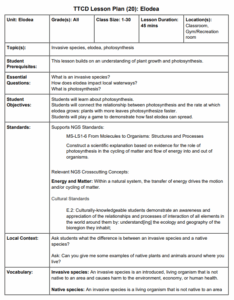
Essential Inquiries & Learning Targets
Core Essential Questions:
- Why is Elodea considered Alaska’s first and most dangerous submerged aquatic invasive plant?
- How does vegetative fragmentation allow a single tiny plant broken by a floatplane rudder to infest an entire watershed?
- How do we distinguish invasive Elodea from native look-alikes by counting leaf whorls?
- What Clean, Drain, Dry biosecurity protocols protect Alexander Lake and West Cook Inlet salmon streams?
Student Learning Objectives:
- Use botanical magnification to count leaf whorls (3 per node for native vs 4-5 for invasive Elodea).
- Model vegetative fragmentation reproduction and calculate exponential colonization rates.
- Develop an aviator biosecurity checklist for floatplanes landing on remote Alaskan lakes.
Virtual Laboratory Simulator
Microscopic Leaf Whorl & Biosecurity Lab
Inspect aquatic plant specimens under simulated magnification, count leaves per whorl to distinguish native look-alikes from invasive Elodea, and execute the Clean Drain Dry checklist.
Field Inquiry Parameters:
Explore step-by-step variables, observation metadata, and field testing protocols directly from the official TTCD curriculum guide.
📋 Protocol Checklist
- Follow teacher safety guidance and ethical collection standards.
- Record 3 independent trials for data repeatability.
- Compare local Tyonek observations with published Alaska State Standards.
Comprehension Mastery Quiz
Test student understanding of scientific principles, local Alaska ecology, and problem-solving scenarios from the lesson guide. Earn the Aquatic Biosecurity Officer credential!
Why is Elodea so catastrophic to native salmon habitat in Alaska?
Specialized Vocabulary Flashcards
Click the card or press Space to flip. Use arrow keys to navigate.
Vegetative Fragmentation
A form of asexual reproduction where a broken piece of plant stem or root regenerates into a complete, independent new plant.
A single 1-inch Elodea stem fragment caught on a floatplane rudder can seed an entire lake system without seeds or flowers.
Curriculum Standards & Activity Protocol
📚 Standards Alignment (NGSS & Alaska Cultural Standards)
Construct an argument supported by empirical evidence that changes to physical or biological components of an ecosystem affect populations.
NGSSEvaluate the claims, evidence, and reasoning that the complex interactions in ecosystems maintain relatively consistent numbers and types of organisms.
NGSSCulturally-knowledgeable students recognize the interrelationships between human activities and aquatic ecosystems.
Cultural🏔️ Local Alaskan & Tebughna Context
- Elodea was discovered in Alexander Lake within the Mat-Su basin and West Cook Inlet region, prompting emergency eradication.
- Floatplanes flying between Anchorage lakes (like Lake Hood, the world’s busiest seaplane base) and remote Tyonek lakes are the primary vector.
- Dense Elodea mats slow water velocity, trap sediment, deplete dissolved oxygen, and ruin gravel beds needed by spawning salmon.
📦 Required Materials & Classroom Setup
🔬 Step-by-Step Hands-on Activity Guide
- Step 1: Observe Leaf Attachment Nodes
Float the plant stem in a shallow dish. Locate nodes where leaf whorls radiate outward.
💡 Instructor Tip: Focus the lens directly on the stem junction.
- Step 2: Count Leaves Per Whorl
Count the number of leaves radiating from multiple consecutive nodes along the stem. Record counts in a lab table.
💡 Instructor Tip: 3 leaves per whorl = Native Waterweed (Elodea canadensis native form); 4-5 leaves per whorl = Invasive Brazilian elodea / Elodea nuttallii hybrid.
- Step 3: Execute Clean Drain Dry Inspection
Roleplay a floatplane pilot checklist: inspect rudder cables, water pump compartments, float transoms, and anchor lines for hitched fragments.
💡 Instructor Tip: Even a 1/2 inch green fragment can regrow an entire colony!
💬 Wrap-Up Discussion & Evidence of Learning
Discussion Questions:
- Why is early detection and rapid response (EDRR) critical for aquatic invasives in remote Alaska?
- How does protecting salmon gravel from Elodea support tribal food sovereignty?
Evidence of Learning Rubric:
- Student can distinguish 3-leaf vs 4-leaf whorls under a lens.
- Student explains vegetative fragmentation and why mechanical mowing spreads Elodea.