
Ecosystems & Wildlife 🎯 Grades 3-12 ⏱️ 60 minutes 👥 1-30 students

Beluga Echolocation & Marine Acoustic Ecology

Cook Inlet Marine Mammals • Tyonek Tribal Conservation District Curriculum

Interactive Digital Curriculum

Interactive Walkthrough Slides

Step through the complete digitized curriculum deck with illustrated concepts, step-by-step procedures, teacher tips, and interactive knowledge checks.

🖥️ Interactive Walkthrough Slides
Slide 1 of 6
Download PDF
Slide 1 Species Overview

The Canary of the Sea: Cook Inlet Belugas

Navigating Zero-Visibility Waters off Tyonek Beaches

Cook Inlet beluga whales (Delphinapterus leucas) are pure white odontocete cetaceans that spend their entire lives in the cold, churning waters of Cook Inlet.

Glacial rivers dump immense loads of fine glacial silt into the inlet, making the water look like creamy chocolate milk. Under the surface, visibility is virtually zero—eyesight is completely useless for hunting fish!

  • 🔊
    Acoustic Masters: Instead of sight, belugas see the world through sound waves.
  • 🛡️
    Critically Endangered: Fewer than 330 Cook Inlet belugas remain today, making habitat protection vital.
← / → Navigate slides F Fullscreen Esc Exit fullscreen
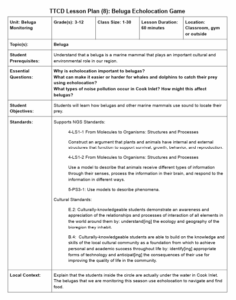
Official curriculum guide preview for Beluga Echolocation & Marine Acoustic Ecology
📄 8.-Beluga-Echolocation-Game.pdf

Essential Inquiries & Learning Targets

Core Essential Questions:

  • How do Cook Inlet beluga whales (Delphinapterus leucas / belukha) hunt and navigate through pitch-black, glacial silt waters?
  • How does echolocation function mechanically through the melon and acoustic fat channels of the lower jaw?
  • How does human noise pollution from ships, pile driving, and oil rigs disrupt beluga communication and feeding?

Student Learning Objectives:

  • Explain the anatomical mechanism of odontocete echolocation: phononic lips, melon beam focusing, and jaw acoustic fat.
  • Participate in the blindfolded echolocation simulation game to locate salmon prey using sound reflection alone.
  • Evaluate conservation threats facing the critically endangered Cook Inlet beluga whale population.
Self-Grading Assessment

Comprehension Mastery Quiz

Test student understanding of scientific principles, local Alaska ecology, and problem-solving scenarios from the lesson guide. Earn the Beluga Echolocation & Marine Acoustic Ecology Master credential!

📝 Comprehension Mastery Quiz Question 1 of 1

Through what anatomical part does a beluga whale receive returning sound echoes from swimming salmon?

Terminology & Dena’ina Context

Specialized Vocabulary Flashcards

🗂️ Interactive Vocabulary Deck Card 1 of 3

Click the card or press Space to flip. Use arrow keys to navigate.

Term Click to flip ↷

Echolocation

Definition & Context Click to flip ↶

Biological sonar where high-frequency sound pulses are emitted and their returning echoes analyzed to detect the distance, shape, and speed of objects.

Alaska Context:

Marine Biology

Educator Guide

Curriculum Standards & Activity Protocol

📚 Standards Alignment (NGSS & Alaska Cultural Standards)

4-PS4-2

Develop a model to describe that light reflecting from objects and entering the eye allows objects to be seen.

NGSS

🏔️ Local Alaskan & Tebughna Context

  • Cook Inlet belugas are a distinct, genetically isolated population of approximately 300 individuals that feed heavily on eulachon (hooligan) and salmon directly off Tyonek beaches.
  • Glacial rivers (Susitna, Little Susitna, Beluga) make Cook Inlet waters so murky that visibility is zero inches beneath the surface.

📦 Required Materials & Classroom Setup

✓ Blindfold (bandana or scarf)✓ Sound shakers or small rattle containers✓ Open circular space (gym or cleared room)✓ Bluetooth speaker for marine noise simulation

🔬 Step-by-Step Hands-on Activity Guide

  1. Step 1: Circle Boundary

    Form large student boundary circle representing Cook Inlet.

  2. Step 2: Quiet Baseline

    Blindfold Beluga student and run baseline echolocation game.

  3. Step 3: Noise Masking

    Introduce background engine rumble noise and record capture time.

  4. Step 4: Debrief

    Compare capture success rates with and without acoustic noise.

💬 Wrap-Up Discussion & Evidence of Learning

Discussion Questions:

  • Why is underwater noise just as dangerous as chemical water pollution for belugas?
  • Why do Cook Inlet waters have zero visibility compared to clear ocean water?

Evidence of Learning Rubric:

  • Student accurately explains the melon and jaw mechanism of echolocation.
  • Student articulates how human noise pollution impairs feeding and navigation.
← All Youth Lessons & Resources